Pakistan’s Costly DRS Blunders Against Bangladesh in Sylhet Test
Contents
Pakistan’s Costly DRS Blunders Haunt Them in Sylhet Test Against Bangladesh
Pakistan’s performance in the ongoing second Test against Bangladesh at the Sylhet International Cricket Stadium has once again drawn significant attention, particularly regarding their on-field judgment and decision-making. Despite making an ideal start with the ball, the visitors were plagued by two critical Decision Review System (DRS) blunders that not only sparked widespread criticism but also significantly impacted the flow of the game.
An Ideal Start Followed by Early Success
After winning the toss, the Men in Green made the strategic decision to bowl first, capitalizing on the favorable conditions. This move paid immediate dividends as Mohammad Abbas struck on just the second ball of the match, dismissing Mahmudul Hasan Joy for a duck after he edged one behind. It was a dream start, setting a confident tone for Pakistan.
However, Bangladesh showed resilience through Tanzid Hasan Tamim, who played with commendable confidence, while Mominul Haque anchored the innings cautiously at the other end. The pair managed to add 44 runs for the second wicket before Pakistan broke through again. Tanzid, having scored 26 off 34 balls, attempted a half-hearted pull shot against Abbas, only to top-edge it for an easy dismissal. The early breakthroughs suggested Pakistan was firmly in control.
Following Tanzid’s departure, Bangladesh skipper Najmul Hossain Shanto joined Mominul Haque. Their brief 19-run partnership looked promising, but Pakistan maintained relentless pressure. Khurram Shahzad then delivered a superb nip-backer that shattered Mominul’s stumps, sending the left-hander back to the pavilion for 22 off 41 deliveries. At this stage, Bangladesh were three wickets down, struggling despite some promising individual starts, and the Shaheens appeared to be firmly in the driver’s seat.
The First Major DRS Blunder: Mushfiqur Rahim Escapes
The turning point, or rather a series of missed opportunities, began soon after lunch. Pakistan had a golden chance to claim another crucial wicket but failed to capitalize due to poor judgment, a decision that would later be highlighted as a significant oversight. The incident occurred in the 28th over when Sajid Khan bowled a short delivery drifting down the leg side.
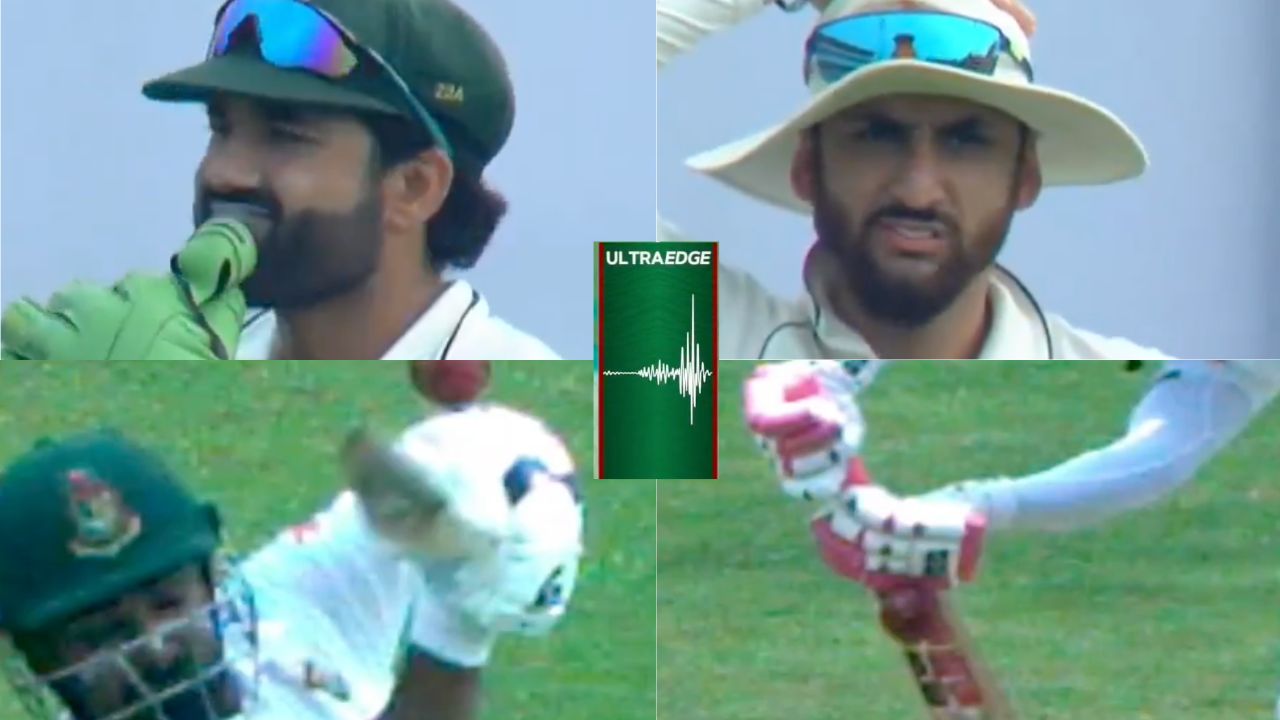
Mushfiqur Rahim attempted to glance the ball fine but clearly missed it. Mohammad Rizwan, behind the stumps, collected the ball cleanly and immediately appealed for a caught behind. While Sajid Khan looked extremely confident in his appeal, Rizwan himself appeared uncertain. Amidst the confusion and a lack of decisive communication, captain Shan Masood ultimately decided against taking the review. This decision proved to be immensely costly. Replays subsequently revealed a clear deflection off Mushfiqur Rahim’s gloves, with UltraEdge confirming definite contact. Pakistan had squandered a massive opportunity to dismiss an experienced batter, a moment of visible disappointment etched on the faces of the Pakistani players as they watched the confirmation on the big screen.
Repeating the Same Costly Mistake: Litton Das Gets a Reprieve
One would expect a team to learn from such a glaring error, but remarkably, a similar incident unfolded later in the innings, underscoring a perplexing lack of game awareness. During the 61st over, Khurram Shahzad delivered a short-of-length ball outside the off stump. Litton Das shuffled across, attempting a pull shot, but failed to connect convincingly. This time, Mohammad Rizwan showed significant interest in the appeal, sensing an edge. However, Khurram Shahzad, the bowler, was not entirely convinced himself.
Once again, captain Shan Masood chose not to review the umpire’s decision. The unfortunate truth for Shan Masood and his team was revealed moments later: the replay, once again, showed a clear spike on UltraEdge as the ball passed Litton Das’s glove. Pakistan had missed yet another undeniable review opportunity. The frustration was palpable, with Salman Ali Agha and Mohammad Rizwan reacting in sheer disbelief after witnessing the replay on the giant screen. These two blunders, occurring within a relatively short span, underscored a critical weakness in Pakistan’s on-field decision-making under pressure.
Litton Das Capitalizes and Rescues Bangladesh
Despite Pakistan dominating large portions of the innings and applying continuous pressure, Bangladesh found a heroic figure in Litton Das. At one point, Bangladesh were reeling at 116/6, facing a potential collapse under the relentless bowling of Mohammad Abbas and Khurram Shahzad. However, Litton Das seized the reprieves offered to him and produced a sensational counter-attacking knock, turning the tide of the innings.
The wicketkeeper-batter smashed a magnificent 126 runs off just 159 deliveries, a defiant innings that single-handedly dragged Bangladesh from deep trouble to a respectable total. His century was not just a display of exceptional batting but also a direct consequence of Pakistan’s missed DRS opportunities. Ultimately, Bangladesh were bowled out for 278 runs in 77 overs on Day 1, a total that seemed improbable when they were six wickets down, largely thanks to Litton Das’s heroics and Pakistan’s strategic blunders. These missed reviews proved to be incredibly costly, allowing Bangladesh to post a competitive score and leaving Pakistan to ponder what might have been.