Tickner five-for wraps up innings win for New Zealand – Blair Tickner’s Five-for Seals Dominant Innings Victory for New Zealand Over Ireland
New Zealand Dominates Ireland with Comprehensive Innings Victory
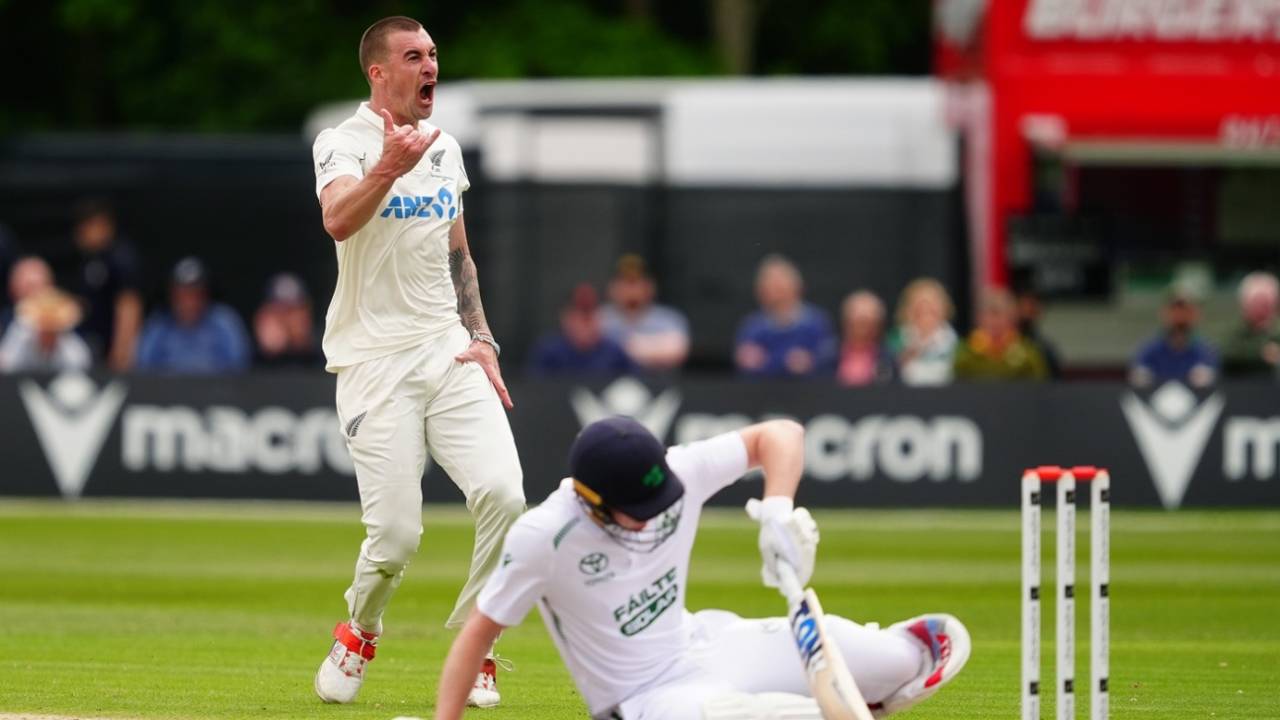
New Zealand delivered a commanding performance to defeat Ireland by an innings and 79 runs, wrapping up the Test match decisively on the third day. Pacer Blair Tickner was the architect of New Zealand’s victory in the second innings, claiming his maiden five-wicket haul in Test cricket, complemented by Nathan Smith’s six-for in Ireland’s first innings. Despite valiant half-centuries from Stephen Doheny and Lorcan Tucker, Ireland’s efforts were not enough to stave off the inevitable against a formidable New Zealand side.
Ireland’s Uphill Battle on Day Three
Ireland began the third day in a precarious position, following on at 65 for 2, still trailing New Zealand by a substantial 246 runs. With two full days of play remaining, a significant rearguard action was required to save the match. Fortunately for the home side, temperatures in Belfast finally dropped below 20 degrees Celsius, offering some respite from a recent heatwave, and overhead clouds brought the promise of conditions more conducive to swing bowling.
Morning Session: Kiwi Pacers Strike Early
The morning session saw New Zealand’s bowlers continue their relentless attack. Nathan Smith, who had already wreaked havoc in the first innings with an impressive six-for, wasted little time in making an impact. Within the first five overs of play, Smith’s full inswinger found the edge of nightwatcher Thomas Mayes’ bat, sending him back to the pavilion via a catch at second slip. Opener Stephen Doheny, resuming his innings on 26, showed commendable footwork and watchfulness against the early swing from both ends.
Despite the overcast conditions that typically aid conventional swing, New Zealand’s strategy involved a concerted short-ball attack. Both Smith and Tickner consistently aimed bouncers at the Irish batsmen, a tactic that soon paid dividends. In the 26th over, Blair Tickner secured his third wicket of the innings when a sharply angled bouncer into Harry Tector’s shoulders saw the ball ping off his bat handle straight to second slip. This dismissal further deepened Ireland’s woes, reducing them to 131 for 5 by the time rain brought an early end to the first session.
Adding to Ireland’s growing list of concerns, Curtis Campher was forced to retire hurt after being struck by a bouncer. Having struggled against the short deliveries, one reared up and hit his left hand, necessitating scans and leaving Ireland effectively a batter down for the remainder of their innings. This incident highlighted the intensity of the New Zealand pace attack and the difficult conditions faced by the Irish batsmen.
Just before the close of the first session, Stephen Doheny, who had shown admirable resilience, also succumbed to the short-ball barrage. Fending at a short delivery from Tickner, he gloved the ball to gully, becoming the third consecutive batter to depart due to the New Zealanders’ aggressive tactics. His dismissal was a crucial blow, as he had been a pillar of stability for Ireland.
Post-Lunch Resistance and Tickner’s Five-Wicket Haul
When play resumed for the second session, the clouds had partially cleared, and with them, some of the Dukes ball’s pronounced swing dissipated. New Zealand adapted their tactics, spreading their fielders to pack the off side. This change in conditions and field placement allowed Lorcan Tucker to capitalize, as he began to drive deliveries outside off with confidence. Tucker skillfully navigated the short balls, punishing anything wide, and swiftly brought up his fifty off just 69 deliveries, offering a glimmer of hope for the Irish faithful.
However, any aspirations of a significant Irish rearguard action were quickly extinguished as Tucker fell on the very next ball after reaching his fifty. He attempted to swing across the line at another bouncer, miscuing it over the keeper’s head, where Daryl Mitchell, running in from the slips, completed a sharp catch. This wicket effectively ended Ireland’s realistic chances of extending the match.
Mark Adair, batting at No. 9, injected some much-needed flair into the Irish innings. He adopted an aggressive approach against Tickner and Zak Foulkes, who continued to direct bouncers at his grille. Adair’s unconventional solution involved shuffling into the leg side to create room for cross-batted swats, often finding the relatively vacant midwicket boundary. His audacious style saw him race to an unbeaten 44 off just 47 balls, marking Ireland’s quickest knock in this Test by a considerable margin.
Adair’s run-scoring opportunities eventually slowed as the New Zealand bowlers adjusted, either angling their bouncers further into the leg side or aiming yorkers at his feet. Despite the tactical shift, his spirited knock provided some entertainment and demonstrated a fighting spirit within the lower order.
The match ultimately concluded when Reuben Wilson became the last batter out. Stuck in his crease, he wafted at a delivery outside off and edged it to the wicketkeeper, bringing an end to Ireland’s second innings. This final wicket not only sealed New Zealand’s dominant innings and 79-run victory but also completed Blair Tickner’s well-deserved maiden five-wicket haul, securing a comprehensive win with four sessions to spare.
New Zealand’s All-Round Excellence
New Zealand’s victory was built on a foundation of all-round excellence. Their first innings declaration at 490 for 8 was fueled by exceptional centuries from Tom Blundell (186) and Rachin Ravindra (121), alongside a near-century from Dean Foxcroft (98). This monumental total put immense pressure on Ireland from the outset. Furthermore, Nathan Smith’s destructive spell of 6 for 40 in Ireland’s initial innings ensured the follow-on, setting the stage for New Zealand’s comprehensive victory.
Upcoming Challenges for Both Nations
Following this dominant performance, New Zealand will now travel to London to prepare for a highly anticipated three-Test series against England, a formidable challenge that will test their mettle. Meanwhile, Ireland will return home to await the arrival of India at the end of June for a T20I series, shifting their focus to the shorter format of the game after a challenging Test outing.